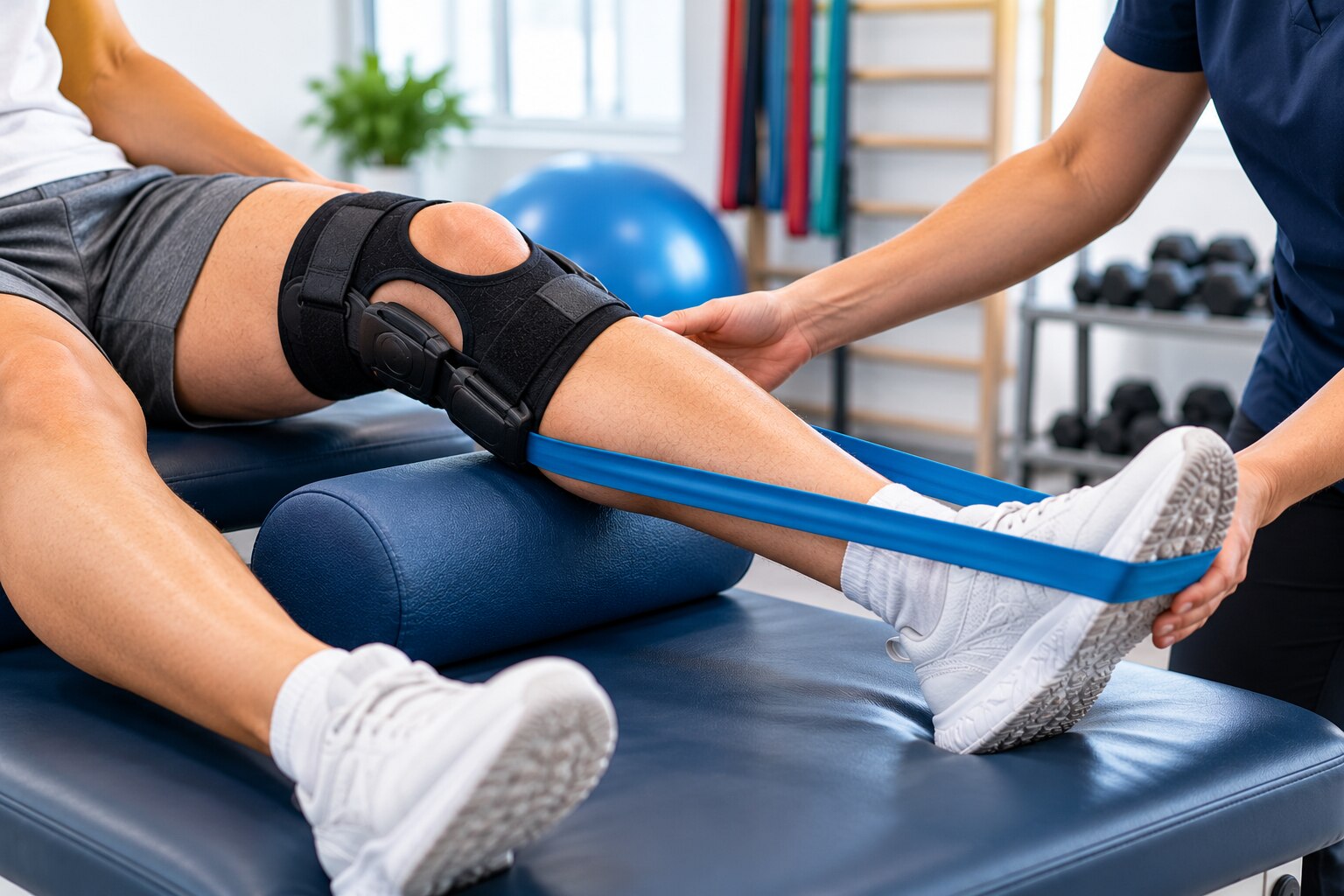
The right physiotherapy plan depends on the operation, the tissue being protected, and your current movement and strength—not simply on whether treatment happens before or after surgery. You will be able to match common knee procedures with the appropriate rehabilitation phase, identify exercises and precautions, and choose between home-based, supervised, and local care.
Key takeaways
- Get surgical assessment first for a locked, hot, deformed, or weight-bearing painful knee.
- Match exercises and restrictions to the exact knee operation performed.
- Progress from protection to walking, strength, balance, and sport in measured stages.
- Combine supervised sessions with home exercises when progress needs monitoring.
When preoperative physiotherapy helps—and when assessment must come first
The answer to which knee physiotherapy is best before or after surgery depends on the diagnosis, planned operation and surgeon’s restrictions. Start with an assessment when the knee is locked, deformed, rapidly swelling, hot and red, or too painful to bear weight; physiotherapy must not delay urgent surgical review.
Preoperative knee physiotherapy suits a planned operation when your surgeon has confirmed the diagnosis and cleared exercise. It should prepare you for recovery rather than “train through” worsening symptoms:
- Reduce swelling and pain so movement becomes easier.
- Restore full knee extension and improve comfortable flexion.
- Build quadriceps, hamstring and hip strength without aggravating the injury.
- Improve walking and teach crutch use, transfers and stair technique.
- Practise the exercises and restrictions you will follow after surgery.
Before ACL reconstruction, useful targets include a straight knee, controlled swelling, active quadriceps contraction and a steady gait. Operating on a markedly swollen, stiff knee increases the rehabilitation problem, but delaying surgery depends on instability, associated injuries and the surgeon’s assessment.
Ask for a written exercise plan that matches the procedure. Meniscal repair, meniscectomy, knee replacement, patellar stabilisation and osteotomy impose different loading and movement limits, so a programme copied from another patient can cause harm. When the diagnosis or operation remains uncertain, assessment comes first.
Match the rehabilitation plan to the operation, not just the knee
The operation determines the restrictions, loading and milestones, so copied knee physiotherapy options can set recovery back. Before surgery, focus on swelling, range of motion, quadriceps control, gait and crutch practice when the surgeon permits it.
| Operation | Before surgery | After surgery |
|---|---|---|
| ACL reconstruction | Restore full extension, reduce swelling and improve quadriceps control | Progress from weight-bearing and strength work to running, jumping, cutting and sport drills using strength and movement criteria, not time alone |
| Meniscus repair | Preserve motion and learn planned crutch use | Protect the repair with restricted flexion or weight-bearing until cleared; progress later than after meniscectomy |
| Meniscectomy | Build strength and maintain walking tolerance | Restore motion, reduce swelling and strengthen progressively; loading usually advances faster than after repair |
| Total or partial knee replacement | Practise transfers, stairs and exercises within tolerance | Emphasise active motion, quadriceps work, walking and daily tasks; a continuous passive-motion machine is not routinely essential |
| Patellar stabilisation or other patellar surgery | Control swelling and improve quadriceps activation | Follow brace, flexion and weight-bearing limits before advancing strength and balance |
| Fracture fixation | Maintain safe movement and prepare for mobility restrictions | Protect the fixation and bone-healing site; weight-bearing changes only when imaging and the surgeon allow |
| Cartilage procedure | Improve motion and strength without aggravating symptoms | Use carefully staged weight-bearing and impact restrictions before higher-load exercise |
| Osteotomy | Strengthen safely and learn the expected walking aids | Protect the bone cut, then increase loading after healing evidence and surgical clearance |
Supervised rehabilitation becomes particularly important when restrictions are complex or progress stalls. A home programme can support straightforward replacement recovery, but it must still track extension, flexion, swelling, walking, strength and function.
What changes from protection to walking, strengthening, and sport
Postoperative knee rehabilitation should progress from protection to controlled walking, then strength and movement quality, and finally running or sport. The calendar matters less than pain, swelling, range of motion, strength and movement control. Hands-on treatment, taping or electrical stimulation can support pain relief or quadriceps activation, but they cannot replace exercise and task practice.
| Phase | Main goals | Exercises |
|---|---|---|
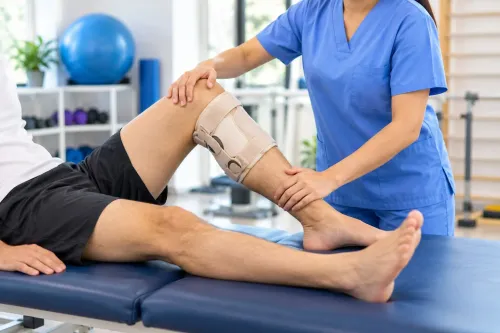
| Protection and activation | Control swelling, restore extension, protect repaired tissue | Ankle pumps, gentle quadriceps sets, straight-leg raises when permitted, heel-prop extension, prescribed range-of-motion work, safe transfers and crutch practice |
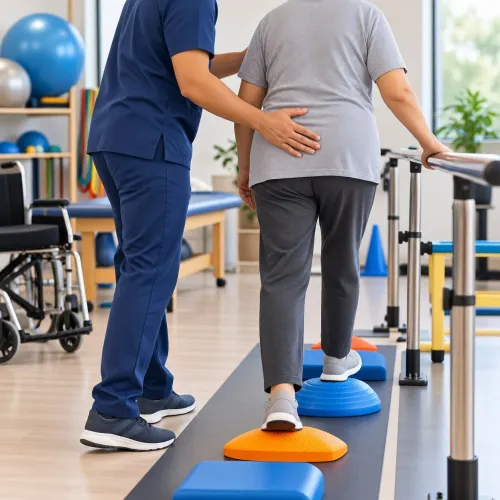
| Walking and mobility | Improve gait, knee flexion, weight-bearing and daily function | Short walks, sit-to-stand practice, supported mini-squats, step-ups, stationary cycling with low resistance when cleared |
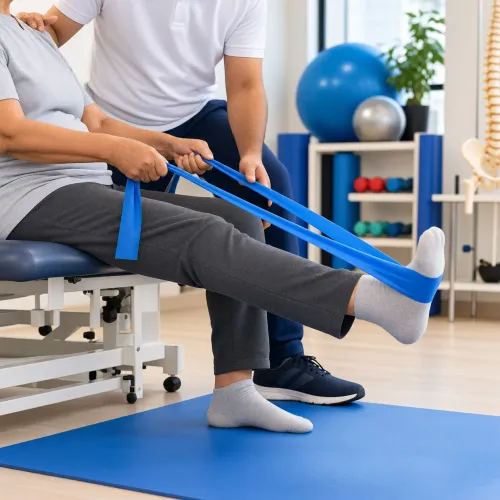
| Strength and control | Rebuild quadriceps and hip strength and reduce movement faults | Progressive resistance exercises, leg press, bridges, hamstring work, single-leg balance and controlled stair practice |
| Running and sport | Restore power, landing control and confidence | Jogging, hopping, jumping, deceleration, cutting and sport-specific drills after strength and movement criteria are met |
Advance only when the current load settles without increasing swelling, pain or loss of motion. After ACL reconstruction, full extension, minimal effusion, adequate quadriceps strength and controlled single-leg movement matter more than reaching a particular week.
After knee replacement, prioritise walking, extension and tolerable flexion; a continuous passive-motion machine is not routinely necessary, and forcing painful flexion can aggravate the knee.
Choose supervised care, home exercise, or both by measuring progress
Choose supervised physiotherapy when you need technique correction, help controlling pain or swelling, equipment, progression after a complex operation, or accountability. A well-designed home programme can produce similar functional results to outpatient therapy after uncomplicated total knee replacement when you understand the exercises, can move safely, and complete them consistently.
| Option | Best fit | What to measure |
|---|---|---|
| Supervised care | Unclear precautions, poor confidence, limited strength, complex surgery, or stalled progress | Range of motion, quadriceps strength, gait, stairs, swelling, and exercise response |
| Home programme | Safe mobility, reliable technique, suitable equipment, and consistent motivation | Exercise completion, walking tolerance, pain, swelling, and weekly functional gains |
| Both | You need coaching but can practise independently between visits | Home adherence plus objective changes at review appointments |
Do not judge knee physiotherapy options by how modern an exercise looks. Judge the load by your response and your operation’s restrictions.
Adjust the plan and contact your physiotherapist or surgeon if:
- Swelling increases across sessions or remains worse the next day.
- Pain repeatedly exceeds a tolerable level instead of settling after exercise.
- Knee extension decreases, flexion stops improving, or a new stiff pattern appears.
- Quadriceps control, walking, stair use, or transfers deteriorate.
- You cannot follow the surgeon’s precautions or complete the programme safely.
Hands-on treatment, taping, or stimulation can support pain control and muscle activation, but progressive strengthening, movement practice, and task training remain the main measures of recovery.
How to choose knee surgery physiotherapy in Kharadi
The search term knee surgery physiotherapy kharadi identifies a location, not a standard treatment. Before starting, choose a clinic that treats your exact operation, follows the surgeon’s written precautions, measures progress, and has a clear escalation plan if recovery stalls.
| Operation | Ask the clinic to explain | Warning sign |
|---|---|---|
| ACL reconstruction | Graft-protection limits, extension goals, and return-to-running tests | A generic knee-strengthening plan |
| Meniscus repair | Weight-bearing and bending limits set by the surgeon | Advice copied from meniscectomy rehabilitation |
| Knee replacement | Walking, extension, flexion, transfer, and swelling goals | Reliance on passive machines instead of active exercise |
Ask these questions before your first session:
- Who will review the operative note, imaging, wound status, medicines, and weight-bearing instructions?
- Which measurements will you record, such as knee extension, flexion, swelling, quadriceps control, walking distance, and stair ability?
- What exercises are safe this week, and which movements or loads are prohibited?
- How will you modify treatment if pain, swelling, stiffness, wound problems, calf pain, fever, or loss of function develops?
- When will you contact the surgeon rather than continue routine therapy?
Alam's Physio Care can be considered only after you verify that the physiotherapist’s plan matches your procedure and surgeon’s restrictions. Distance matters less than correct protection, measurable progression, and appropriate communication.
Frequently asked questions
When does preoperative knee physiotherapy help?
Preoperative physiotherapy can improve movement, strength, swelling control, and confidence before surgery when the diagnosis and surgical plan are clear. Assessment must come first if the knee is locked, deformed, rapidly swollen, hot and red, or too painful for weight-bearing.
Why must postoperative knee rehabilitation match the operation?
A knee replacement, ACL reconstruction, meniscus repair, and fracture surgery have different loading limits, movement targets, braces, and timelines. Follow the surgeon’s restrictions and the physiotherapist’s plan for the specific operation.
How does rehabilitation progress after knee surgery?
Postoperative knee rehabilitation usually moves from protecting the repair and controlling pain and swelling to safe walking, restoring range of motion, rebuilding strength, improving balance, and returning to work or sport.
Should you choose supervised physiotherapy, home exercise, or both?
Use supervised care when you need exercise correction, progress testing, swelling or pain review, or help meeting surgical milestones. Add a prescribed home programme to build consistency between appointments.
How do you choose knee surgery physiotherapy in Kharadi?
Ask whether the clinic assesses your operation, communicates with your surgeon when needed, measures range of motion and strength, explains restrictions, and gives a specific home programme. Alam's Physio Care provides physiotherapy and rehabilitation support in Kharadi.
Keywords