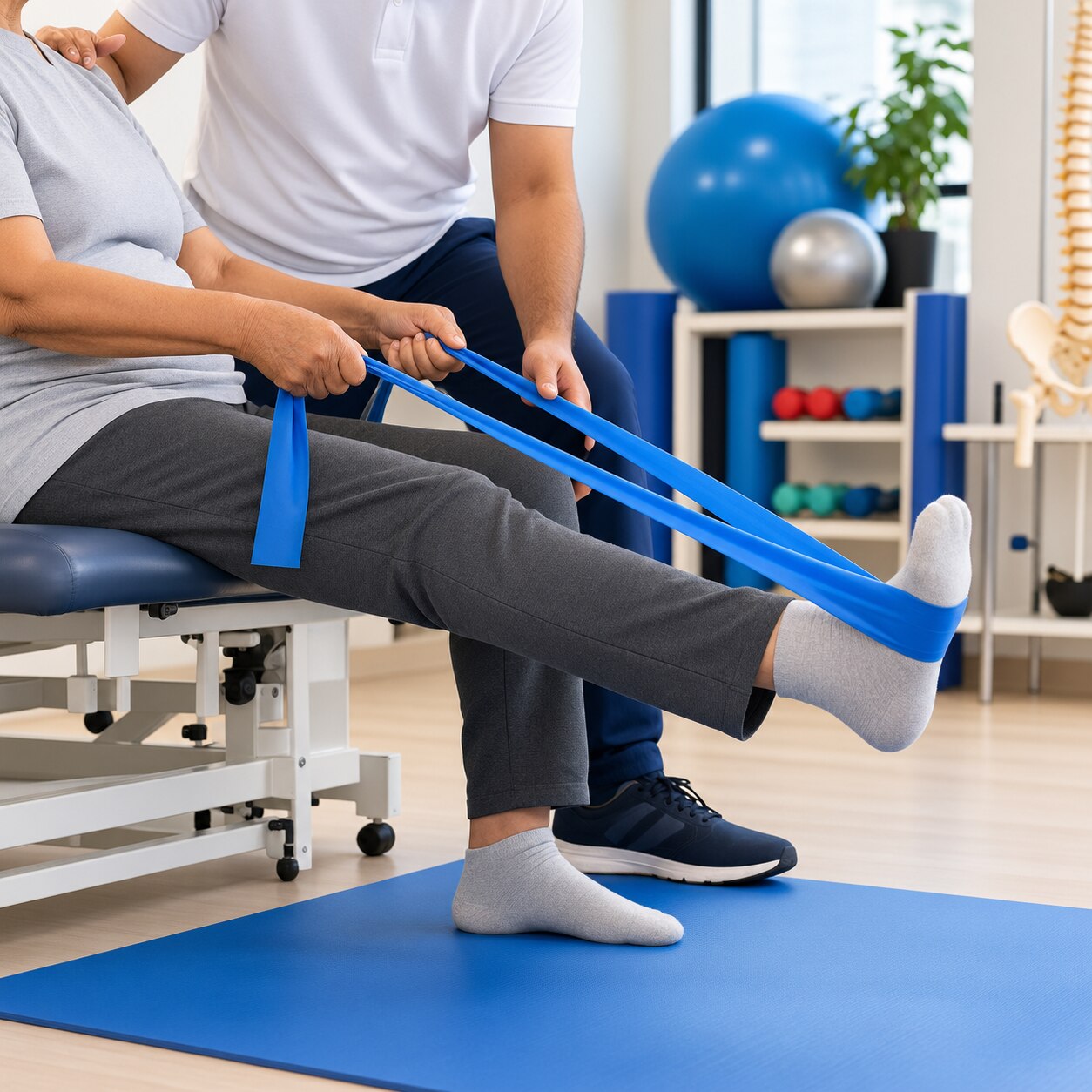
A first appointment involves more than checking a painful joint: the physiotherapist needs to understand falls, dizziness, medicines, daily tasks, walking confidence, and the conditions that affect exercise safety. By the end, you will know what to bring, what tests and movement observations to expect, how exercises are selected, and how progress is reviewed.
Key takeaways
- Bring medication lists, medical reports, walking aids, spectacles, and supportive footwear.
- Expect checks of falls, dizziness, pain, strength, balance, walking, vision, and hearing.
- Exercises begin at a safe level and progress through repetitions, resistance, or balance demands.
- Review progress using practical goals such as safer transfers, walking, and stair use.
Before the First Appointment: What the Physiotherapist Needs to Know
Bring a current medication list, scan or operation reports, spectacles, hearing aids, walking aids, and supportive footwear. The opening conversation covers falls and near-falls, dizziness or orthostatic symptoms, pain, vision, hearing, continence, cognition, and fear of falling.
Tell the physiotherapist how you manage daily activities, stairs, transfers, and walking, and describe home hazards such as loose rugs, poor lighting, or missing handrails.
Be ready to explain your personal goals. You might want to stand from a low chair, reach the bathroom safely, or walk outside again. This information shapes what happens during geriatric physiotherapy: the therapist identifies risks and chooses relevant tests instead of treating age or pain in isolation.
Information to prepare:
- Falls, near-falls, dizziness, faintness, or symptoms after standing
- Pain location, severity, triggers, and effect on movement
- Medication changes, including blood-pressure or sedating medicines
- Vision, hearing, memory, continence, and fear of falling
- Usual walking aid, transfers, stairs, daily activities, and home layout
- Goals for movement, confidence, independence, and community participation
| Information | Why it matters | What it may change |
|---|---|---|
| Falls or dizziness | May indicate balance, blood-pressure, medication, or cardiovascular risk | Safety checks and test selection |
| Pain or recent surgery | Determines tolerable movement and loading | Range, support, pace, or referral |
| Home routine and goals | Shows which tasks matter most | Task practice and home advice |
What Happens During a Geriatric Physiotherapy Assessment
The therapist physically assesses how you move through everyday tasks, not just the painful joint. During a senior mobility physiotherapy session, the therapist may observe:
- Rolling and repositioning in bed
- Rising from a chair
- Transferring between a bed, chair, and toilet
- Turning while standing or walking
- Walking with your usual aid
- Climbing steps
- Getting into and out of a vehicle
These observations reveal where movement breaks down: weakness, poor balance, slow reactions, pain, stiffness, unsafe hand placement, or difficulty using a walking aid.
The therapist may also use named measures to establish a functional baseline:
- Timed Up and Go test: stand from a chair, walk 3 metres, turn, walk back, and sit down
- 30-Second Chair Stand Test: count controlled rises from a chair in 30 seconds
- 4-Stage Balance Test: hold progressively harder standing positions
- Gait-speed measurement or structured gait observation
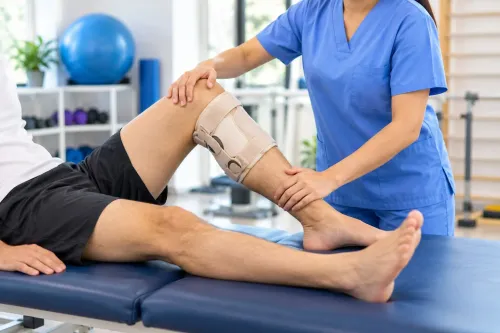
- Range-of-motion checks at relevant joints
- Manual muscle testing of key muscle groups
The therapist records technique, speed, steadiness, breathing, pain, and the level of help required. A geriatric physiotherapy assessment does not turn one test score into a diagnosis. The findings must be interpreted alongside your falls history, symptoms, medical conditions, walking aid, medications, cognition, and other examination results.
Together, they show a starting point for choosing safe treatment and measuring functional progress.
How Findings Become a Safe, Individual Treatment Plan
The plan starts with your goal, not a test score. If you struggle to rise from a low chair, the therapist may prioritise hip and knee extensor strength, chair-height practice, and repeated sit-to-stands; if turning causes loss of balance, treatment targets trunk control, ankle reactions, and turning technique.
During a senior mobility physiotherapy session, task practice often begins immediately because strength that does not transfer to daily movement has limited value. Rolling, sit-to-stand, transfers, turning, stair practice, and walking may sit alongside targeted work for the hip and knee extensors, ankle muscles, and trunk.
Safety and difficulty are adjusted through specific decisions:
- Raise the chair, add hand support, shorten walking distance, reduce speed, or choose a firm surface when weakness, arthritis, pain, or fear makes the task unsafe.
- Use controlled loading and avoid forceful bending or twisting with osteoporosis; protect surgical precautions after recent surgery.
- Allow extra time, clear cues, visual targets, and close supervision after stroke, with Parkinson’s disease, or with cognitive impairment.
- Monitor exertion, chest symptoms, breathlessness, dizziness, and blood pressure with heart disease or low blood pressure; stop and seek medical review for concerning symptoms.
- Check feet, sensation, glucose-management instructions, and balance support with diabetes or neuropathy, because reduced feeling can hide injury or instability.
The therapist then sets repetitions, rests, walking-aid use, and supervision around your actual performance, progressing only when technique remains safe. A bathroom route, outdoor walk, or staircase becomes the measure of useful improvement.
Which Exercises Are Used, and How Are They Progressed?
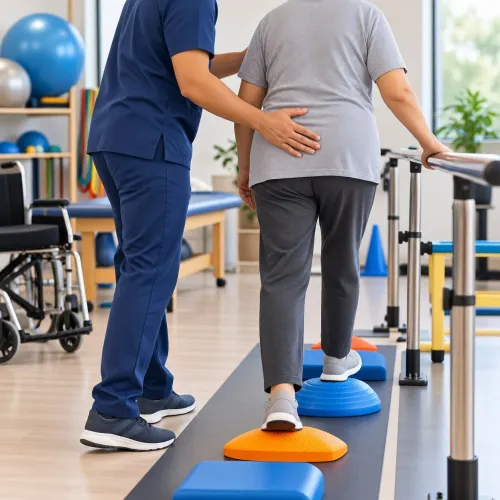
A therapist selects elderly balance physiotherapy exercises that challenge control without creating unsafe risk. Examples include supported sit-to-stands, heel raises, marching at a counter, side-stepping, weight shifts, tandem stance, reaching tasks, step-ups, turning, obstacle negotiation, and dual-task walking while responding to a cue.
- Supported sit-to-stands build hip and knee strength for transfers.
- Heel raises and marching target ankle control and foot clearance.
- Side-stepping, weight shifts, tandem stance, reaching, and turning train balance in different directions.
- Step-ups and obstacle negotiation prepare for stairs and uneven paths.
- Dual-task walking adds conversation, counting, or responding to instructions after basic walking is safe.
| Exercise | Easier starting point | Progression |
|---|---|---|
| Sit-to-stand | High chair, hands supported, fewer repetitions | Lower chair, less hand support, added resistance |
| Walking balance | Counter or rail held continuously | Fingertip contact, longer distance, turns or obstacles |
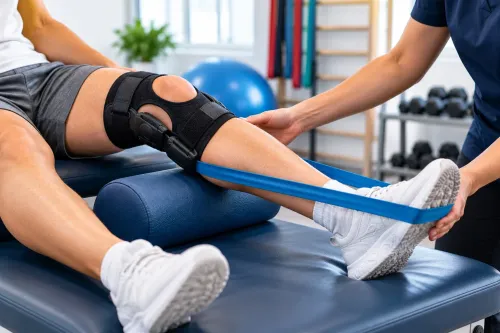
| Strength work | Body weight, short sets, longer rests | Resistance, more repetitions, shorter rests |
The therapist adjusts support, repetitions, rest periods, resistance, and frequency for technique, symptoms, fatigue, fear, weakness, wheelchair use, and caregiver dependence. Continuous hand support can be reduced as control improves, but supervision remains when needed.
A written home programme states frequency, repetitions or time, setup, walking-aid instructions, and acceptable symptom response. The WHO recommends multicomponent balance and strength activity on at least three days weekly when feasible; shorter bouts may suit low endurance.
Stop and seek exercise modification or medical review for chest symptoms, breathlessness, dizziness, new neurological symptoms, unusual fatigue, or a marked walking change.
Follow-Up, Progress Checks, and Choosing Care in Kharadi
After the first session, the therapist compares follow-up performance with your baseline rather than judging progress by pain alone. What happens during geriatric physiotherapy may include repeating the Timed Up and Go, chair stands, balance, gait observation, transfer ability, walking confidence, and everyday goals such as reaching the bathroom or managing stairs.
| Follow-up finding | Therapist response | Why it matters |
|---|---|---|
| Safer, smoother movement | Increase repetitions, distance, speed, or task difficulty | Builds useful capacity |
| Pain, fatigue, dizziness, fear, or medical change | Reduce the task, add support, rest, or seek medical review | Prevents unsafe pushing |
| Persistent falls risk | Review medicines, vision, footwear, home hazards, and cardiovascular causes alongside exercise | Exercise alone may miss the cause |
For older adult physiotherapy Kharadi, ask whether the provider performs an individualized assessment and screens for referral needs before progressing exercises. Ask how risks are explained, how tasks are adapted for your home and community, and whether the written plan is realistic for the older adult and caregiver.
Alam's Physio Care is one local option to compare on these clinical points, not simply on location. Choose the service that measures function, explains decisions clearly, and changes the programme when symptoms or medical conditions change.
A suitable plan should show what to practise, how often, what support to use, and when to stop and seek help.
Related service
Gentle, effective treatments for seniors to improve mobility, reduce fall risk, and enhance overall quality of life. Physiotherapy Service Types for Geriatric Patients 1. Geriatric Assessment Services Comprehensive evaluation of the elderly patient’s functional... View service → |
Frequently asked questions
What should you bring to a geriatric physiotherapy appointment?
Bring a current medication list, scan or operation reports, spectacles, hearing aids, walking aids, and supportive footwear.
What happens during a geriatric physiotherapy assessment?
The physiotherapist discusses falls and near-falls, dizziness, orthostatic symptoms, pain, vision, hearing, continence, cognition, and fear of falling, then assesses movement and function.
How does a physiotherapist create a safe treatment plan for an older adult?
The plan connects assessment findings with practical goals and selects exercises, assistance, equipment, and progression levels that match the person’s safety and ability.
Which exercises are used in geriatric physiotherapy?
A senior mobility physiotherapy session can include strength, walking, sit-to-stand, flexibility, coordination, and balance exercises, progressed through repetitions, resistance, support, or task difficulty.
How is progress monitored after geriatric physiotherapy?
Follow-up reviews compare symptoms, walking, transfers, balance, strength, confidence, and daily activities against the goals set during the initial assessment.
Keywords