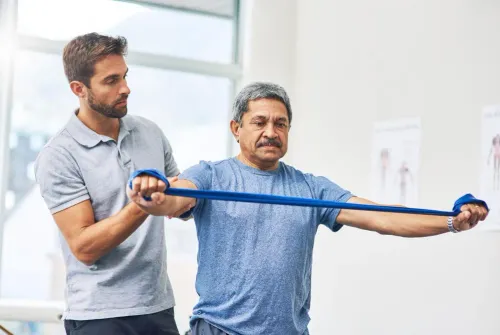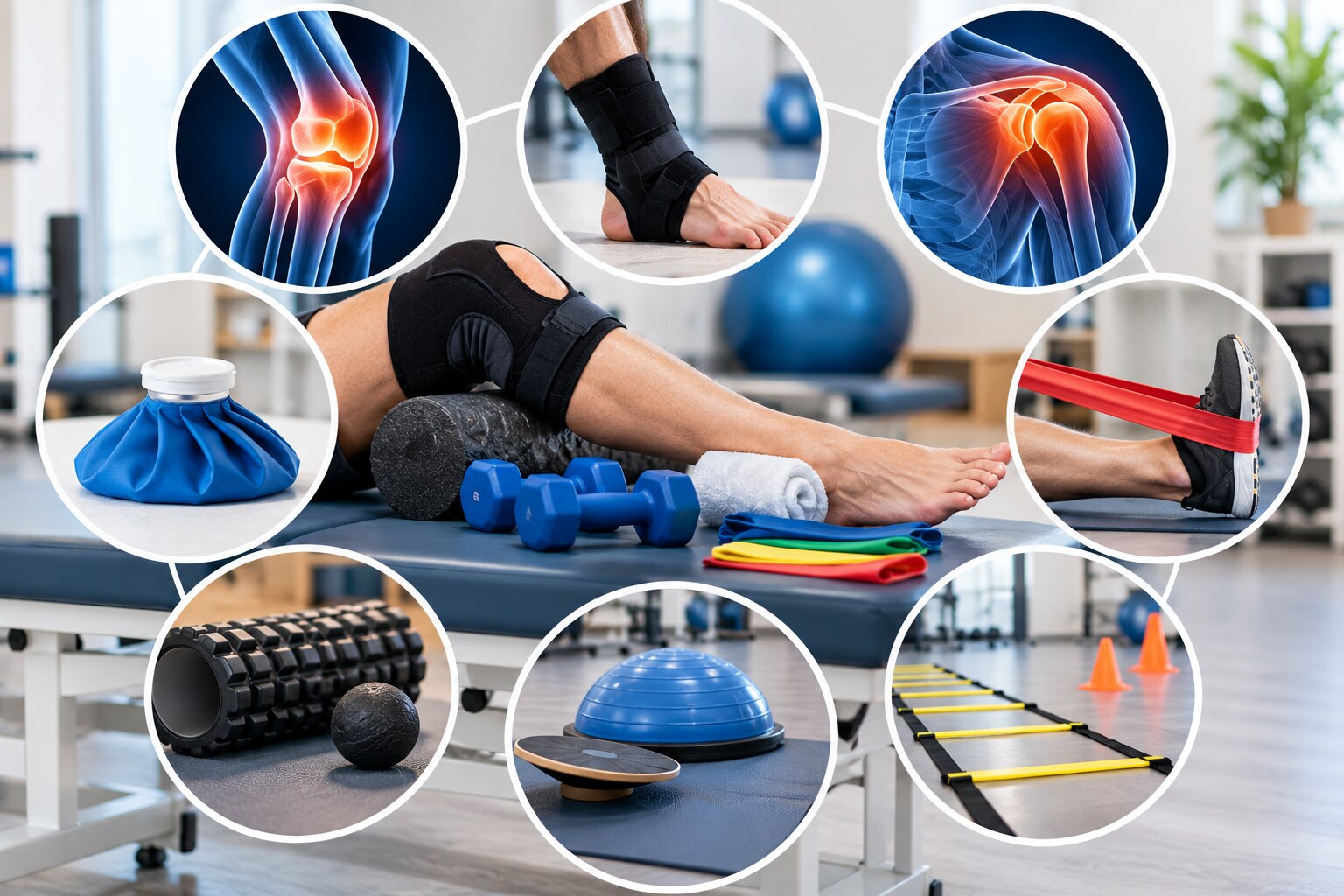
Starting rehabilitation safely requires more than choosing exercises from a generic programme. You need to know whether the injury is suitable for routine physiotherapy, what the assessment will examine, how loading will progress, and which tests show that your body is ready for sport again.
Key takeaways
- A physiotherapist checks injury history, swelling, movement, strength, and warning signs first.
- Sprain and ligament rehabilitation prioritises protection, stability, range of motion, and progressive loading.
- Muscle strain rehabilitation increases load gradually while monitoring pain, flexibility, and strength.
- Return to sport requires pain-free movement, near-symmetrical strength, and sport-specific testing.
What happens before you begin exercises?
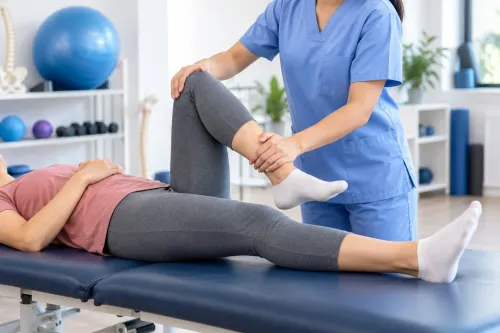
A physiotherapist first decides whether you are ready for routine rehabilitation or need medical assessment. What does sports injury rehabilitation include at this stage? It includes an injury history, physical examination, movement testing, and a safe starting plan.
You will be asked how the injury happened, where symptoms are located, when they began, and whether they are changing. The physiotherapist also checks recent training load, previous injuries, current pain, walking ability, work demands, and sporting limitations.
The examination may assess swelling, joint range of motion, strength, gait, movement quality, and neurovascular status when relevant. Do not begin routine exercises before medical review if you have:
- Suspected fracture or dislocation
- A complete tendon or ligament rupture
- Major joint instability
- Severe or worsening swelling
- Numbness, or a cold or pale limb
For acute ankle trauma, the Ottawa Ankle Rules support radiographs when you have bone tenderness at the posterior edge or tip of either malleolus, the base of the fifth metatarsal, or the navicular, or when you cannot take four steps.
| Term | Meaning | Consequence |
|---|---|---|
| Working diagnosis | The best clinical explanation from current findings | Guides initial rehabilitation and referral decisions |
| Confirmed diagnosis | A diagnosis established through appropriate medical assessment or imaging | May change the treatment plan |
Symptoms or function that fail to improve as expected require reassessment. The rehabilitation plan must change rather than continuing the same exercises automatically.
How does rehabilitation progress from assessment to treatment?
Rehabilitation starts with a physical examination, then movement testing reveals what the injury prevents you from doing safely. The clinician uses these findings to form a working diagnosis or arrange referral, then sets measurable treatment goals.
1. Establish the baseline: record pain response, swelling, range of motion, strength, balance, movement quality, and daily or sporting function.
2. Set the first goals: protect the injured area, restore safe movement, control symptoms, and regain basic weight-bearing. Your sports injury rehabilitation treatment details should match the injury, severity, training demands, and medical findings.
3. Begin the home and clinic programme. Early soft-tissue care may follow PEACE: protection, elevation, avoiding unnecessary anti-inflammatory strategies, compression, and education. PEACE is an early-care framework, not the whole programme.
4. Progress active rehabilitation. Exercises restore motion, strength and capacity, coordination, balance, and confidence. The programme may advance from protected movement and basic weight-bearing to running, jumping, cutting, contact practice, full practice, and competition.
5. Review the response repeatedly. The clinician checks pain, swelling, range, strength, balance, movement quality, and function before increasing load.
Symptoms or swelling later the same day or the next morning mean the current load needs reassessment, not automatic advancement. A later review can change the diagnosis, exercises, referral plan, or return-to-sport stage when progress does not match expectations.
What changes for a sprain or ligament injury?
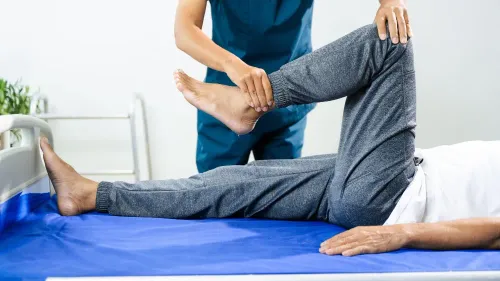
A sprain rehabilitation physiotherapy programme controls swelling, uses taping or a brace when indicated, restores safe weight-bearing, and rebuilds joint motion. Range-of-motion work comes before calf and lower-limb strengthening, balance and proprioception training, hopping, landing, cutting, and sport-specific drills. Manual therapy can reduce short-term pain or improve ankle dorsiflexion, but it cannot replace active exercise.
The site changes the priority:
| Site | Main priorities | Later progression |
|---|---|---|
| Ankle | Dorsiflexion, calf strength, single-leg balance, and preventing recurrent giving-way | Hopping, landing, cutting, and sport-specific movement |
| Knee | Full extension, swelling reduction, quadriceps activation, and single-leg control | Running, jumping, deceleration, and change of direction |
| Shoulder instability | Controlled range, rotator-cuff and scapular strength, and safe loading positions | Progressive overhead, contact, and sport-specific loading |
Ligament injury physiotherapy treatment depends on the injured ligament, associated damage, instability, and surgical plan. A stretched ligament, partial tear, complete tear, and post-operative reconstruction do not follow the same timetable.
An apparently minor ankle sprain still deserves review if the ankle repeatedly gives way or pain, swelling, weakness, or restricted movement persists; roughly 40% of people may develop chronic ankle instability or continuing symptoms. The programme must address those deficits rather than wait for bruising to disappear.
How is a muscle strain rehabilitation programme different?
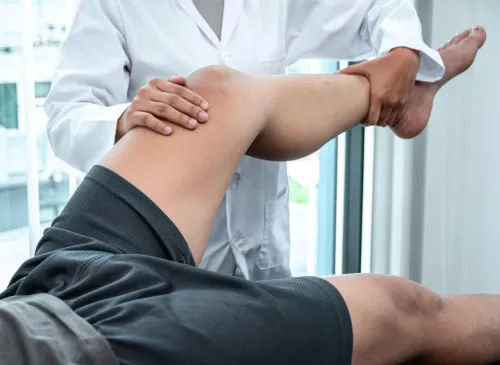
A muscle strain rehabilitation programme is staged to rebuild the force and speed that injured the muscle, not simply to remove pain. Brief protection from aggravating activity is followed by pain-limited movement; pain-free walking does not prove readiness for sprinting, cutting, or repeated high-speed efforts.
The usual progression is:
- Isometric or low-load contractions that maintain activation without provoking symptoms.
- Progressive strengthening as tolerance improves.
- Lengthening exercises and high-force eccentric work for the hamstring or similar muscle.
- Energy-storage exercises, followed by acceleration, deceleration, and jumping.
- Sport-specific drills and near-maximal sprinting before competition.
Stretching, massage, and complete rest alone do not prepare muscle fibres to absorb force, produce force quickly, or tolerate repeated lengthening. Advancing too quickly can reproduce the injury; staying at rest can leave strength and load tolerance inadequate.
| Cause | Typical clue | Rehabilitation focus |
|---|---|---|
| Tendon pain | Pain linked to tendon loading | A gradual tendon-loading plan, not a strain protocol |
| Bone injury | Focal bone tenderness or impact pain | Medical assessment, possible imaging, and impact restriction |
| Dislocation | Joint displacement or marked instability | Prompt medical assessment and stability management |
| Delayed-onset muscle soreness | Begins after unfamiliar exercise and improves as recovery occurs | Relative recovery and gradual return to usual loading |
A tendon problem needs a different loading target, while suspected bone injury or dislocation should not be managed as an ordinary strain. A clinician should reassess the diagnosis if symptoms or function fail to improve as expected.
What must you pass before returning to sport?
A calendar date does not complete rehabilitation. The practical answer to what does sports injury rehabilitation include is a staged progression: normal daily activity, basic exercises, running, faster and multidirectional work, non-contact practice, full practice, and competition. Pain or swelling later that day or the next morning means reassess the load rather than advance automatically.
| Stage | What must be demonstrated | Why it matters |
|---|---|---|
| Daily activity | Normal walking, stairs, and work without increased symptoms | Shows basic tolerance |
| Running | Comfortable steady running with controlled symptoms | Tests impact capacity |
| Speed and direction | Acceleration, deceleration, cutting, and jumping with sound mechanics | Exposes control and force deficits |
| Practice | Non-contact, then full practice without next-day swelling | Recreates sport demands |
| Competition | Objective tests and psychological readiness are satisfactory | Confirms readiness for game intensity |
Return-to-play testing is matched to the injury and can include:
- Full joint range, stable pain and swelling response, and useful movement quality
- Quadriceps and hamstring strength, single-leg control, and hop performance
- Landing and cutting mechanics, repeated-sprint ability, and confidence under pressure
For ACL reconstruction, testing batteries often use a 90% limb-symmetry threshold. Passing 90% does not remove reinjury risk, and pain alone is not clearance: low-demand clinic work can hide poor force production, balance, or confidence. These sports injury rehabilitation treatment details help clinicians decide whether capacity matches competition.
Choose a service that performs a clinical assessment, records measurable baselines, progresses sport-specific loading, and refers for medical review when findings exceed routine rehabilitation. Alam's Physio Care is a Pune option for readers seeking that assessment-led process.
Related services
sprains, ligament injuries, and muscle strains Specialized care for athletes and fitness enthusiasts. We help you recover faster from sprains, ligament injuries, and muscle strains, ensuring a... View service → |
Pre And Post-Rehabilitation Physiotherapy For Shoulder Pain ₹600 We provide specialized, evidence-based care for a wide range of shoulder conditions, focusing on pain reduction, joint stability, and functional... View service → |
Frequently asked questions
What happens before sports injury rehabilitation exercises begin?
A physiotherapist reviews your injury history, examines the injured area, tests movement and strength, and checks whether you need medical assessment before routine rehabilitation.
How does sports injury rehabilitation progress from assessment to treatment?
Treatment moves from protecting the injury and controlling symptoms to restoring movement, rebuilding strength, adding balance and sport-specific drills, and testing readiness for return.
How does sprain rehabilitation physiotherapy differ from muscle strain rehabilitation?
Sprain rehabilitation focuses on joint stability, swelling control, range of motion, balance, and ligament loading. Muscle strain rehabilitation progresses through pain-free movement, flexibility, strengthening, and running or sport drills.
What changes for a ligament injury during physiotherapy treatment?
The programme depends on the ligament, injury severity, joint stability, and treatment plan. Rehabilitation may emphasise protection, controlled range of motion, strengthening around the joint, balance, and gradual sport-specific loading.
What must you pass before returning to sport?
You should have pain-free or near-pain-free movement, controlled swelling, adequate strength and balance compared with the uninjured side, and successful sport-specific drills without symptoms.
Related services
Treatment for back pain, knee injuries, ligament tears, and arthritis. Orthopedic & Sports Physiotherapy 🏋️ Orthopedic & Sports Physiotherapy Orthopedic and Sports Physiotherapy focuses on the prevention, treatment, and rehabilitation of injuries... View service → |
Personalized recovery programs after orthopedic or neurological surgeries. Personalized recovery programs after orthopedic or neurological surgeries. We focus on regaining strength, flexibility, and confidence in movement. View service → |
Ankle Sprain, Ankle Fracture Rehabilitation,Tendonopathies & Soft Tissue Injuries,Ankle Impingement Syndromes Physiotherapy for ankle injury 🦶 Ankle Physiotherapy & Rehabilitation Ankle rehabilitation is a specialized physiotherapy program designed to restore strength, stability, and... View service → |
PRE AND POST OPERATIVE MANAGEMENT Alams Physio Care provides comprehensive knee management services, including both pre-operative preparation and post-operative rehabilitation. View service → |
Keywords